Flashback 1985. At the round tables beneath old trees of the main campus of the University of San Carlos in Cebu City, Philippines, we Liberal Arts students would spend plenty of time sharing among ourselves anything under the sun. We debated passionately on issues on justice and poverty, shared insights on the latest movie craze, and shared some silly information on crushes and love life.
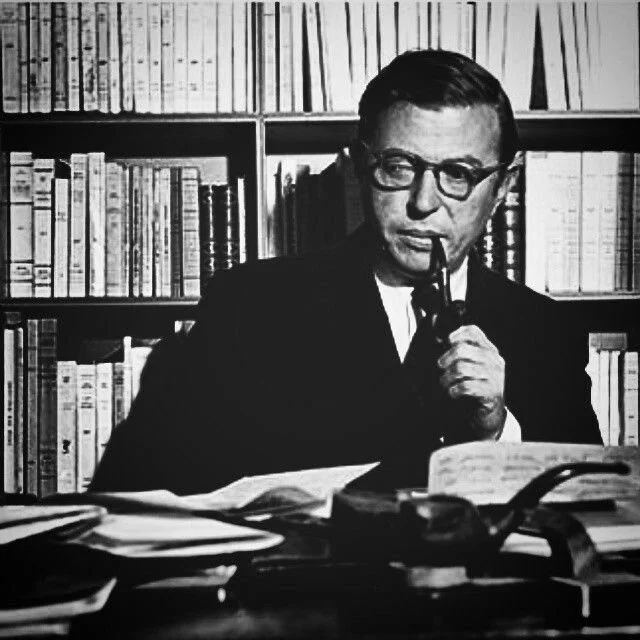
French philosopher Jean-Paul Sartre, father of Existentialism. Existence precedes essence; that we decide what meaningfulness we give to our lives because we are essentially free and must be responsible. (Photo from Pinterest)
During those youthful days, modern day philosopher Jean-Paul Sartre was a popular ‘reference’ for us Psychology, Political Science, and Philosophy majors. At the height of student activism and idealism (it was the last year of Pres. Marcos before he was ousted in a bloodless popular and military uprising in 1986), European philosophers and our own national heroes come alive at the round tables. Sartre was a particular favorite of seminarians (Philosophy majors), as they argued about taking action in the face of political oppression.
Sartre’s Existentialist philosophy provided enlightenment beyond his time and the confines of the French activism against the spread of communism in Europe. The existentialist philosophy, which underscores the “freedom and responsibility” of individuals was the rationale heartily used by activist students, religious persons, and professionals to join the call for the end of Marcos dictatorship.
Existentialism, in the Philippine experience of activism, I would say, ran deep and quietly among many activists like a personal code of conduct. But in the tumultuous days of the anti-Marcos dictatorship, what was clearly played up on the surface was the political philosophy of Marxism (as a tool for analyzing society using class conflict) which was likewise very well discussed in universities as a natural habitat for the revolutionary ideas of the youth.
In retrospect, that same existential philosophy was the elemental inspiration for activists in Latin America’s pedagogy of the oppressed and liberation theology. I became a believer and actor of “freedom and responsibility” at an early age of my life, which to me was a good thing. I thought I was being a mature individual, in my teens. Although I no longer live the same kind of political activism in my youth, the “freedom and responsibility” ethic had been my take-away every since university days.
Thirty years later, in this graduate school class of UTS, I came up close and much more in focus with Sartre, and I could never be more thrilled and enlightened. His philosophical thought: “man is fully responsible for his nature and his choices” has outlived him and has no doubt continued to encourage people to take on their freedom and responsibility in the realm of the here and now.
I embrace this philosophy and believe that I am living through this kind of consciousness. It has, most especially when at the crossroad of critical decisions, been my defining ethic. When I assert my freedom and do my responsibility, it affords me a good night’s sleep. I guess I have valued a really good sleep, free of guilt or remorse, all this time.
Existentialism at the Turn of the Century
Existentialism, a philosophy that acclaims the freedom of the individual human being, became popular at the turn of the 21st century. (Internet Encyclopedia of Philosophy) Sartre gave existentialism a popular flare and pragmatism, having been inspired by Friedrich Nietzsche, Karl Marx, and his lifelong partner philosopher and feminist leader Simone de Beauvoir.
He began writing about existentialism in the darkest hours of his incarceration and uncertainty of life as a prisoner of war during WWII. His book, “Being and Nothingness” was considered to be his greatest work. It noted that human being is a no-thingness and is opposed to being or thingness.
In this book, Sartre focused on the study of consciousness of being. He said that being-in-itself are such things as glass, rock, goat; while being-for-itself (the human being, is nothing). Sartre mentioned that the human being unravels as it relates to the other, or the state where individual beings become for others (being responsible, finding meaning of one’s existence). (Sartre. www.Britannica.com)
Sartre’s activism was consistent with his philosophy. He criticized the dogmatic and dictatorial application of communism in the Soviet Union and did not join the communist party in his native France. He was against the human rights abuses committed by the Soviet Union in the name of socialism or communism. He also actively participated in the campaign against the war in Vietnam. I believe this made him a respectable free thinker who walked the talk.
Furthermore, Sartre’s eccentric nature and his being anti-establishment were tested when he refused to accept the prestigious Nobel prize, not once but twice. In 1964, his childhood autobiography, Les Mots, won a Nobel Prize for Literature, but he declined to accept it. Sartre explained to the Nobel committee that writers should not be given awards for these will make the writer an institution. And as such, people will read and believe him for he or she has become an institution, instead of looking critically at the merits of his philosophical discourse. Sartre said that the writer may no longer influence his readers genuinely because of the merit of his institutional recognition.
Sartre made a huge philosophical sense with this kind of reasoning. But personally, I do not agree with him for having refused the Nobel Prize for Literature, for the same reason that once institutionalized, I would be able to influence more and more people into my philosophy or craft.
In 1974, Sartre declined the Nobel Peace Prize for his involvement in the campaign to end the Vietnam war with two others, Le Duc Tho and Henry Kissinger. Additionally, he chose not to marry his life long partner Simone de Beauvoir whom he had an open relationship for the very same reason of his being anti-establishment.
Marriage as an institution infringes into personal freedoms, hence he and Simone managed to maintain their partnership without having to ‘tie the knot’ while at some point, getting involved with other persons too.
On both counts, not being married and refusing Nobel Prize twice, are not my cup of tea, certainly not the Sartre’s eccentric way of expressing freedom. But other than that, I am very much a subscriber and actor guided by existentialism.
Phenomenology
Fathered by German philosopher Edmund Husserl, Phenomenology is a philosophical movement that aims to directly investigate and describe phenomena as consciously experienced, without using theories of their causal explanations and freed from conceptions and presuppositions. (Www.americanhumanism.org)
Sartre’s philosophy that “existence precedes essence,” for me, basically questioned the Christian philosophy that human beings were made in the image and likeness of God; that the world was His creation. For Sartre, existence precedes essence which means that we human beings were born without essence (no-thingness) but must find it out for ourselves while we live by living for other.
This rationalization of “must find it out for ourselves our essence or the meaning of living” is the context of Sartre’s existence precedes essence. Human beings, when born into this life or on this Earth, are “no-thing” or “nothing.” He or she must live a life in search for meaning to be able to establish his or her essence, Sartre said.
Additionally, the essence of human beings is always in relation to others to be able to define or establish his or her own meaning and essence. I could not agree more with Sartre.
When a baby is born, a mother is born too. Hence, the social and biological relationship of mother and child. Subsequently, the child is born to a family, where he/she normally has a father, and a sibling or lots of siblings, cousins, aunts, uncles, grandparents, etc.
As life goes on, more relationships are established by the child. As he or she goes to school, relationships with his/her teachers, classmates are established and friendships are developed too.
All throughout life, a human being is always in relation to the other, thus helping or enabling him or her to define his being, i.e., a father, brother, boss, or friend. Funny how Sartre asserts that there is no hell which God has accordingly created. Hell, he said, is brought about by the others. This was the main message of his one act play titled No Exit (also known as Dead End) - a one act philosophical drama performed in 1944 and published in 1945. Its main message: Hell is other people and not a state created by God. (Sartre. www.britannica.com)
But is a relationship with the other enough to establish the essence of a human being? Sartre says no. A person who works as a waiter is more than just a waiter, for example, because waiting tables is only a parcel or a part of that human being.
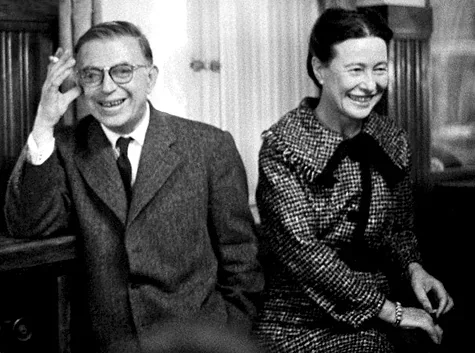
Sartre with life partner philosopher and feminist Simone de Beauvoir (Photo from erartamotionpictures.com)
So what is the essence of a human being really? What is the meaning of existence? Here Sartre answers the profound essence of a human being which is on being responsible for others (and not just by the consequence of having a relationship with others as a result of family or work).
This essence of being responsible for others is manifested in taking up social causes, taking on justice, saying no to corruption, being on the side of truth or with the poor and outcast, being able to respect and honor human rights, these to Sartre are the expression of responsibility. Indeed, I could not agree with him more.
But the essence of being a human being is not served in a silver platter, nor is it defined in grandiose philosophical discourses from universities. Each individual will have to find out for himself or herself what is her/his essence. Some perhaps finds it out early in their 20s or 30s, some would realize it when they are 70 or 80 years old. To Sartre, the entire lifetime of a human being, he has the freedom to choose his own nature or essence. There is no other way. That is why he said, in a rather dark fashion, “Humans are condemned to be free.” Condemned meaning, bound to miserably search for one’s own meaning of human existence and essence.
Until and unless each individual is able to say “this is it”, this is my calling, this is what I will do for humanity, he or she will never actually search for his meaning and establish his or her essence.
On being an Existentialist
I admire Sartre’s introspective mind, critical mindedness, and flexibility. He had thought that Marxism was a way to change the world, free it from the exploitation brought about by capitalism and monarchic systems. But when he saw it for himself - the gross human rights violations and the abuse of power by Marxists in the Soviet Union, he had openly criticized it.
I would not subscribe to Phenomenology alone in understanding humanity’s essence, because it looks at the world and life as purely material and devoid of Divine Power that has caused its creation. The world to me is both phenomenal and noumenal. Human beings are not just material, social or political, but spiritual as well. We have relationships with each other, other animals, inanimate things such as money. But most of all, we too have a relationship with a Divine Being. That the world is phenomenal by itself is great and astounding. But to me, this is not enough. Human beings must acknowledge that they are finite, and that there is a God (or gods or however you may call such Power), which is infinite.
But then again, even the faith and belief in God or a Divine Being, as having caused the creation of the Universe, is a choice of the human being. So I leave it to the individual to decide to believe in God or no god, in whatever purpose it may serve him or her.
In my previous Philosophy class with Dr. Noda (2018), I had mentioned in making sense of the Big Bang Theory and the Creation Theory espoused by the Bible, the natural order of things the world was created by a Divine Intelligence but not in seven days but in billions of years, because for me, God is bound by time and space in creating the material world and the evolution of species. Thus, I could not solely believe in Phenomenology.
On the narrow humanistic sense, I firmly believe in Sartre’s philosophy of Existentialism: that we are essentially free and fully responsible for our choices and the consequences of our decision and actions. We may be born poor or a slave, but the freedom is ours to remain a slave or to stop being one, by escaping or going to school. By creating or seizing whatever opportunity presents to end slavery is our choice and responsibility.
Existentialism to me is a mature way of living. By asserting my freedom and taking responsibility for my actions, I contribute to making our make our world a much better, more justice-filled place to live in. When institutions (be it government, church, or so-called opposition groups) fall because of corruption, treachery, and tyranny, the one person standing is the existentialist. #
(This is the author’s finals essay in her graduate school class on the Philosophy of Human Nature under Dr. Keisuke Noda at the HJI Graduate School for Peace and Public Leadership, 2024.)
Bibliography:
1.Jean-Paul Sartre Biography. www.thefamouspeople.com/profiles/jean- paul-sartre
2.Jean-Paul Sartre French Philosopher and Author.
www.britannica.com/biography/Jean-Paul-Sartre
3. Jean-Paul Sartre Biography Philosophy Existentialism.
Www.age-of-the-sage.org/philosophy/sartre.html
4. Humanism definition. www.americanhumanist.org
5. Edmund Husserl (1859-1938). Internet Encyclopedia of Philosophy.
www.iep.utm.edu/husserl/
6. Simone de Beauvoir (1908-1986). www.iep.utm.edu/Beauvoir
7. Karl Marx. www.britannica.com