The divide began from the top: Can the church and media make immigration stories enlightening?
2nd of 4 parts
Bridging the Political Divide of US Immigration through Transformative Journalism
A 2024 dissertation by Dr. Marivir Montebon
New York – Political polarization did not begin or end with journalists. Media organizations, driven by ideology and commercial interests, have widened polarization by reinforcing the public’s existing political and ideological beliefs.
Marshall McLuhan’s theory of communication “the medium is the message” explains how the ideological nature of the medium, such as media organizations, creates a message that is aligned or consistent with their ideological nature.
The polarization started from the top
Dannagal Goldthwaite Young, in her book Wrong: How media, politics, and identity drive our appetite for misinformation, cited the role of media producers in creating political and ideological polarization.
A sharp ideological polarization of elites in the US occurred in 1994, resulting in increased affective polarization of the public and increased social sorting of the Republican and Democratic parties.
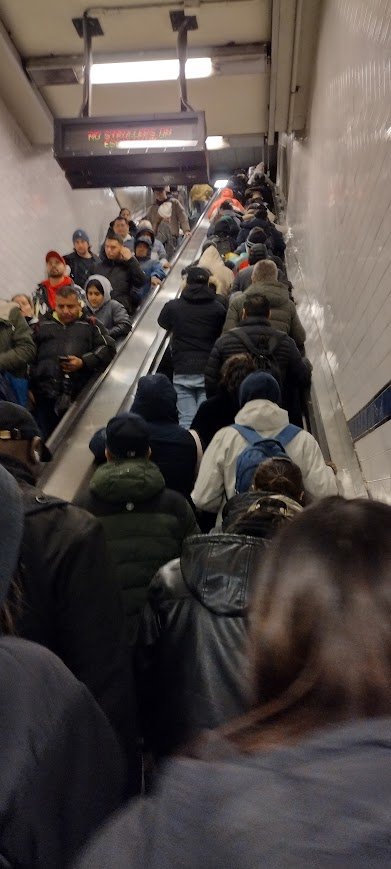
An ordinary day in New York, home to the largest populations of communities of color in the US.
During this year, the internet has emerged, significantly reshaping public communication, and the Republicans took control of Congress in the midterm elections.
Young noted that the increasing ideological polarization of the elites eventually resulted in the birth of MSNBC and Fox News Channel in 1996.
Down the line, political division pervaded. In 2018, a Knight Foundation/Gallup survey showed that people judge news outlets’ bias largely through the lens of their own political identity.
Democrats tended to view outlets like AP, PBS, NPR, The New York Times, CNN, and The Washington Post as relatively unbiased, while seeing Fox News and Breitbart as strongly biased.
Republicans, by contrast, viewed Fox News and The Wall Street Journal as unbiased and considered many mainstream outlets—especially CNN and MSNBC—as biased.
Independents/nonpartisan adults rated a smaller set of outlets, such as PBS, AP, NPR, The Wall Street Journal, and USA Today, as unbiased, but still saw several major outlets as biased.
The poll shows that perceptions of media credibility are deeply shaped by political affiliation, reinforcing broader social and ideological divides.
Harvard University’s The Future of Media Project identified the top three mainstream media of the US that determine cyberspace information as: 1. Wikipedia, owned by Google, earns $1,700,000,000 monthly; 2. Fox, owned mainly by Murdoch, earns $833,000,000 monthly; and 3. CNN, owned by Discovery Media and Warner Media, earns $482,000,000 monthly.
Google, majority owner of Wikipedia, is known to be ideologically neutral but more often used by liberals. Fox, owned by majority shares by Rupert Murdoch, a conservative, gave over $2.5 million mostly to Republicans in the last elections. CNN is owned by Discovery Media and Warner Media, which are identified as liberal. An investigative study by USA Today noted that David Zaslav, who led the merger with CNN and Discovery, donated over $240,000 to the Democrats.
Disinformation as a tool to further polarize people
This study postulates that political polarization in the top segments of American society did not happen by coincidence but rather by intention. The ruling elite made conscious effort at political polarization using their media corporations, with content that is consistent with their ideological views.
Young pointed out that this media production has given rise to the phenomenon of “partisan pundit” where pundits are the talking heads who appear on the news not to “report” news but to talk “about the news.” It has become routine for media producers to assemble panels of pundits who argue about a topic, styled in an interpersonal “in your face” argument, that moves viewers to be engaged and increase their hostility towards the other side.
Pundits arguing on political issues have been elevated nationwide through cable news, intentional in its grand scheme of “nationalizing conflict-framed stories” instead of investing and reporting on complicated policy proposals that have consequences on local communities, said Young.
As a result, audiences make a choice to be engaged with these nationalized panels of eruptions by watching CNN, MSNBC, or Fox, or they decide to tune out. Young concluded that the nationalization of this media production has resulted in the amplification of mega-identities and the public's decline in engagement with their state and local politics.
Intellectual arrogance plays well in these panels, amid interruption and insult and eye rolls, and unfortunately, misinformation too.
A 2015 fact-checking report of the non-partisan fact-checking organization Politifact showed that of the pundit claims they checked, almost 60 percent on Fox News were rated as mostly false or false; 44 percent of pundit claims at MSNBC were false, and 20 percent of pundit claims on CNN were false.
Scholars David Rand and Gordon Pennycook, when asked how misinformation on social media could be slowed down and what lever would they pull to stop the spread of misinformation and conspiracy theories, their response was, without hesitation: delete Fox News and deplatform bad elites.
A study by the Reuters Institute Digital Report 2022 indicates that most of the audiences in the US sorted as far right-leaning get their news mainly from Fox News. Scholars described the character of the sorted American audience demographics as predominantly far right, white, Republican, and Christian Evangelists.
Social psychologist Jonathan Haidt said that although Americans were divided even before the introduction of social media, social media is largely responsible for America’s devolving sense of community, cultural fragmentation, eroding trust in institutions and each other, the spread of misinformation and conspiracy theories, and the rising mental health challenges among young people.
He describes social media as the “dart guns” that give more power to trolls and provocateurs while silencing good citizens. It gives more power and voice to the political extremes while reducing the power and voice of the moderate majority.
What should journalists do?
Young recommended three solutions to the identity-driven wrongness of media work in the US – addressing journalism, social media, and regular people.
Journalists need to engage in democracy-centered reporting, not rewarding or incentivizing partisan performances of identity, abandon conflict-framing in the coverage of politics, and expand community-centered local news and funding for public media.
In social media, Young sought “transparency requirements on algorithmic content rankings and ad targeting, making data available to social science researchers to understand these trends and develop research-based recommendations for the platforms and lawmakers.”
Additionally, regular people “the need to cultivate intellectual humility, disrupting performances of political identity, inclusion, and increasing demand for democracy-centered political information.”
Young has placed her recommended solutions as non-negotiable. “America is a multiracial, multiethnic, multifaith society that requires a pluralist vision of democracy to survive and thrive. An unequal voice, power, or democratic representation by race, ethnicity, religion or sexual identity is incompatible with a pluralistic liberal democracy. Secondly, the freedom of expression is paramount to democratic health.”

A welcoming church in Queens, NY.
How about the Pilgrim Church for enlightenment?
This study highlighted the role of the ‘pilgrim church’ in responding to immigration issues in the US.
In his book Church and Migration: A Theological Vision of the People of God, Daniel Montanez offered a transformative narrative of immigration from the larger lens of human migration. He postulated that the dominant narrative surrounding immigration is highly political and divisive within mainstream and social media.
This book could provide journalists with a fresh perspective from the Bible to be included in the main message of their reports, consciously seeking the experiences and expertise of church-based organizations and nonprofits which are outside the secular narratives of politics. Including religious leaders with ministries for immigrants in their immigration reportage could very well create a more uniting effect within the community.
Montanez encouraged writers to use the grand narrative of Scripture to understand migration from a Biblical-theological perspective. His Church and Migration is an educational guide to better understand Biblical messages about people on the move and how these can be applied in the modern world.
The book casts a “theological vision for how the Church can understand and respond to the phenomenon of global migration and human displacement in ways that are both positive and proactive. It also seeks to invite the Church to respond positively and proactively in serving migrant communities.”
Sammy Alfaro in his essay, “Incarnation and Redemption: Jesus the Migrant,” noted that the story of Jesus cannot be significantly explained without the experience of migration informing his life, teaching, and ministry. His redemptive work stands in solidarity with modern-day immigrants and refugees.
The flight to Egypt, he writes, shows Christ’s solidarity with people displaced by fear and violence. He also presents salvation as holistic, linking the spiritual and physical, the personal and communal, and the human and cosmic.
For Alfaro, Jesus’ crossing of boundaries should move the church to identify with migrants and take up their cause.
This matters in the American context, where a large share of immigrants identifies as Christian and where many congregations already encounter migration as a lived pastoral reality.
Research has also found meaningful support among evangelicals for immigration reforms that combine compassion, legal clarity, and border responsibility. For that reason, the active involvement of churches and religious groups on behalf of immigrants may help soften political hostility and create more constructive public conversation. #
A shorter version is published by TheFilAm www.thefilam.net/archives/45812