Joaquin R. Talisayan: Surviving racial discrimination in the 1930s California
Filipino American history as recounted first-hand by a war veteran and farmer
By Marivir R. Montebon
(This article is a whole chapter of my self-published memoir ‘Biting the Big Apple’ published in 2013 and available on Amazon in print and ebook versions.)
Listening to Joaquin Rubi Talisayan was like going back to a century’s old movie of life in old America when it created vast tracts of corporate plantations and peopled them with immigrants from all over the world.
America’s food basket was/is propelled by millions of immigrants who had to bend their bodies beneath the punishing sun’s heat or despite a fierce cold weather to plant seeds or gather the earth’s bounty.
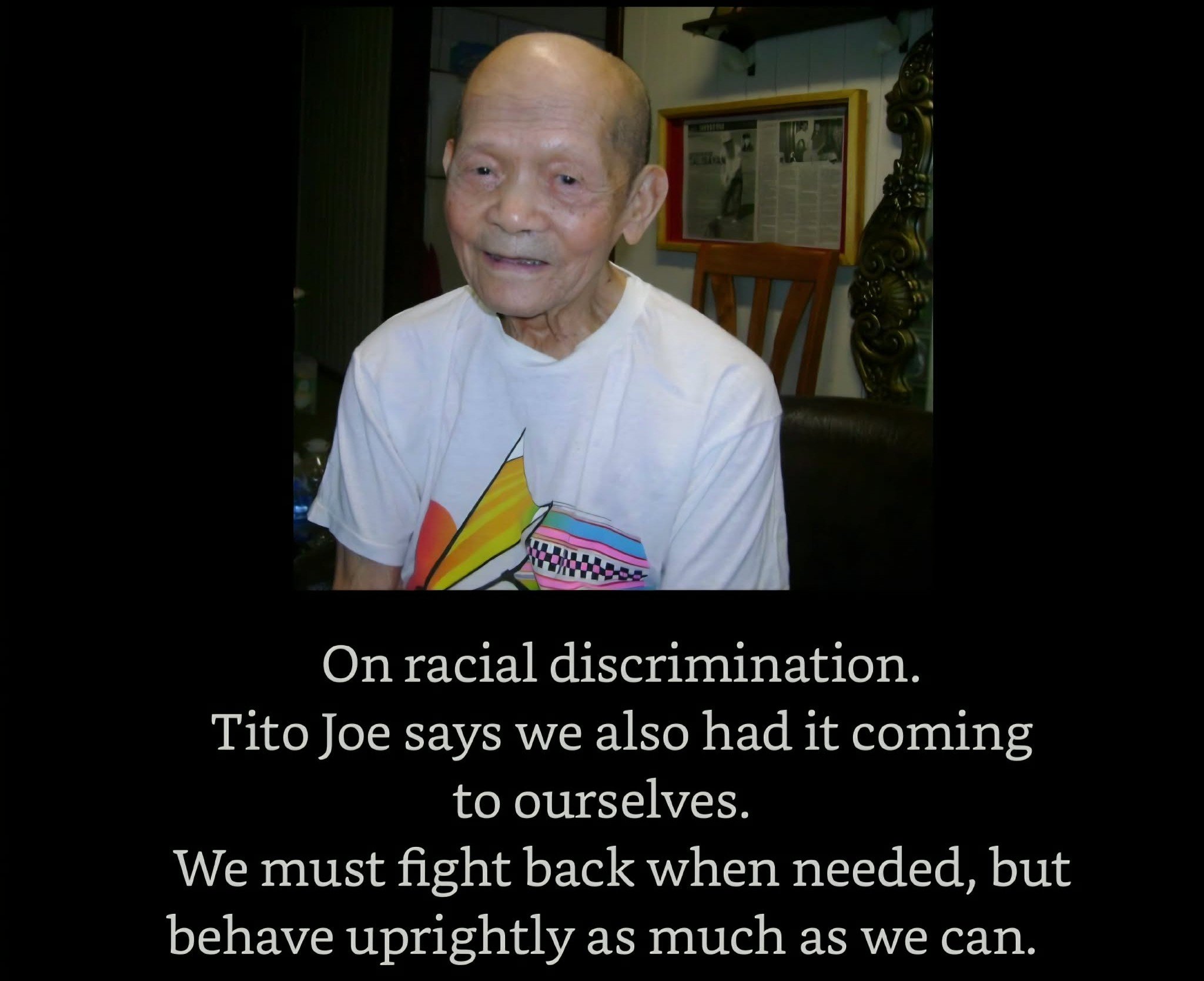
Conversations with Tito Joe, Joaquin Talisayan in his house in Stockton, California, were like watching a movie of the riots of the 1930s. Photo taken in 2006, when he was 100 years old.
Tito Joe was a great uncle, on the side of my mother’s paternal roots. His story, kicking off as a young child raised in the asparagus farms of Hawaii, and eventually becoming an asparagus farmworker himself, into being a student, a Navy volunteer, husband and father, enthralled me no end.
Two afternoons spent with Tito Joe in Stockton meant a priceless and breathtaking thrill of how amazing his journey in life was. “I feel blessed with the enormous number of years,” he told me days after his big birthday celebration in his quaint apartment at the Philippine Federation of America building in Stockton.
His greatest gift, the year when he turned 100, in August 20, 2006, was when the doctor gave him a clean bill of health. Uncle Joe, as we fondly called him, was born in the peaceful town of Larena, on Siquijor island.
He still played golf at least once a week until he was 102 and maintained his vegetable and fish diet. He said good exercise and an absolutely no red meat diet are two of his secrets to a long life. There are two others that he shared.
“I don’t worry. Worrying is a poison to our body. I rarely get angry too. And I have strong faith. I pray every day, in the morning and evening. I pray from the heart. Perhaps this is why I have a long life,” Tito Joe said in a soft voice.
I believe what researchers at the University of Kentucky found out, that being happy can prolong life to at least 10 years, compared to those who were sad. The article entitled Secrets to a Long Life published by ThirdAge.com said that "the trick is to find happiness in everything that you do, live for the moment, and relish the small pleasures of life." It pointed out that being positive adds to at least 7.5 years of one's life. Tito Joe only had fresh fruits and vegetables each day. Processed food was a no.
There was always fresh fish (that was either steamed or grilled) on the table and his favorite vegetable soup - malunggay (Moringa oleifiera) with chicken or fish. Malunggay is a popular greeny leafy vegetable in the Philippines and India that exhibited some health benefits for its users. Now gaining popularity in western medicine, Malunggay is dubbed as the miracle vegetable which has proven to strengthen the immune system, control blood pressure, eliminate headaches and migraines, and manage diabetes sugar levels, ulcers, and arthritis.

Tito Lolo Joe with his wife Aunt Pacing in his home, after our interview. My published conversation with Tito Joe first saw print in 2004 on a local paper in California, which he lovingly mounted on a glass frame.
Tito Joe also walked hand in hand with his wife regularly every afternoon around the block. "When you walk with your loved one, it is both healthy and happy. It makes you feel young all the time," he beamed.
Tito Joe passed away at the age of 104, leaving behind his wife Pacita and sons Joey and Edward with fond memories and utmost respect. Larger than his life, Tito Joe vividly described how it was as a young boy living on the asparagus farms in Hawaii since 1910, and as a soldier and sacada (asparagus farm worker) all throughout his adult life.
He spent most of his younger years working in the US Navy and later, at the Ferry Morse Seed Company and the Moran Seed Company as farm worker and staff member of its research department.
Waves of Filipino immigrants
Tito Joe’s parents, Severino Talisayan and Melecia Rubi, were among the earliest Filipinos who were expatriated to the US to become sugar plantation workers in Hawaii and California between 1910 and 1912.
This was practically about the same time when my great grandfather embarked on a long perilous trip to America. Siquijor Island, located in Central Philippines, was a reservoir of that work force that the US used to steadily build up its powerful agricultural economy.
About 3000 Filipino migrant workers went to Hawaii every year from 1911 to 1920 to work as sugar plantation workers. Hawaiian sugar planters were known to have preferred to import Filipino labor because Filipinos received the lowest wage, compared to Chinese, Japanese, and European counterparts, in the plantation.
Another reason was the legal practicality of hiring Filipino because they were technically US nationals at that time when the Philippines was a colony of the US. The Hawaiian planters also viewed the Filipinos as an alternative labor to use against Japanese workers, who were staging strikes to improve their conditions in the plantations.
They preferred to hire uneducated workers who knew nothing of their legal rights. They also felt that the Filipinos were fit for the job as sacadas because they come from an agricultural country, and as such have been proven to be subservient, industrious, and hardworking.
Tito Joe was a young boy when he left Larena, along with his mother and three other siblings, to join their father who was then working as a sugar plantation worker in Kahuko, Hawaii.
In 1912, the young Talisayan was not quite six years old when he boarded the steam ship with his family, along with 25 others, first to Manila and then to Hawaii for three weeks across the Pacific Ocean.
Tito Joe recalled that he was very sick with flu during the trip, and they thought he would die. He was immediately admitted to the children’s hospital when they arrived in Honolulu and there, regained his good health only after three weeks.
While his parents worked as sugar cane workers, Talisayan and his siblings were sent to school. “Our education was free. And if we helped our parents on the farm, I remember we were given 50 cents for a day’s work. I saw how hard my parents worked for long hours at the farms,” he said.
He finished high school at the St. Louise College in Honolulu, Hawaii. Tuition fee at that time was comfortable for his parents at six dollars a month.
He decided to volunteer for the US Navy as a kitchen crewmember and scoured the seas in Hawaii, New York, and San Francisco.
In 1929, Tito Joe joined his brother Arcangel and sister Bonifacia in San Leandro in California where he worked in the fruit farms of the Ferry Morse Seed Company. He was designated as the assistant to the research department head of the company, where they studied the cross breeding of seeds of tomato, cucumber, and other fruits and vegetables.
He received $1.35 per hour as starting pay and was increased steadily as he worked for the company until 1954. At the time, Talisayan thought his pay was decent enough, especially because he would receive increased bonuses each year for his efficiency as a worker.
“My first-year bonus was $250, $350, then it went to $500, and then to $1000,” he remembered clearly. His employer liked him because he was dedicated to his work and had always been honest.
As Tito Joe managed to eke out a living in America, his parents decided to return to the Philippines, feeling sad and homesick and scared of the intense racial discrimination in the presence of the white Americans and other ethnic groups.
The Great Depression definitely kept everyone restless, violent, and lonely at that time. President Franklin Delano Roosevelt passed the Repatriation Act of 1935 in order send throngs of migrant agricultural workers back to their home countries during the Great Depression.
Severino and Melecia, heeding this law, went home to Siquijor and brought with them their son Arcangel and daughter Trinidad. Bonifacia and Joaquin were headstrong in their decision to continue living in California.
Tito Joe and his older brother Arcangel later realized that his parents’ decision to go back home was a mistake, because while America may have been economically battered, the Philippines’ economic situation remained a standstill.
“You do not come home to the Philippines without money because the economy at home is not improving,” Arcangel strongly advised Tito Joe.
In 1929, he moved to Stockton where he worked as farm worker for a tomato and sugar beets farm owned by Italian brothers. In 1954, he worked and lived in Salinas and worked with the Ferry Morse Seed Company and then with Moran Seed Company until he retired.
Racial Discrimination
While life in Larena remained the same for Arcangel and his parents, Tito Joe’s life in California had always been challenging. Although he kept his job because he has proven himself worthy despite the Great Depression, racial discrimination was an everyday thing to contend with.
Hotels, restaurants, and public places, he remembered, once carried signs that said “Filipinos not allowed to enter here” or “No Filipinos allowed.” The root of the discrimination against Filipinos, said the study on Filipino migration to the US, was economic.
Filipinos were disliked because they willingly worked despite low wages and thus were taking the jobs of white people. The whites preferred hiring Filipinos since their physique was perceived to be ideal for "stoop labor" that required a lot of bending when cutting asparagus and planting cauliflower.
Tito Joe remembered that Filipinos were stereotyped as half-civilized, worthless, and unscrupulous, luring white women, and prone to crime and violence.
The Caucasian American’s jealousy and hatred of the Filipinos likewise caused racial riots. The first race riot occurred in Exeter, California, on the night of October 24, 1929.
A mob of 300 men stormed a Filipino camp, stoned and clubbed about 50 Filipinos, and burned the barn. About 200 Filipinos were driven out of the district due to the riot. The white Americans were angered when they lost their jobs to Filipinos in harvesting Kadota figs and Emperor grapes.
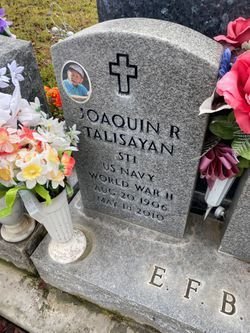
Joaquin R. Talisayan, a life well lived.
The most explosive riot was recorded in Watsonville, where the Northern Monterey Chamber of Commerce adopted anti-Filipino resolutions. On January 11, 1930, a small Filipino club leased a taxi dance hall from two Americans in Palm Beach.
The thought of Filipinos dancing with white women angered Watsonville citizens. On January 20, 1930, about 200 Americans hunted Filipinos on the streets, and on the following day, the dance hall was raided.
Two days later, Filipinos were beaten and one was killed, a man by the name Fermin Tobera, by a mob of 500 angry white Americans who also destroyed the Filipino quarters, the study reported.
Tito Joe recalled that the riots were also instigated by jealous white Americans who saw Filipino men dating or courting American women. Gender statistics at that time in California counted 14 men to one woman, hence the steep rivalry. This situation made him decide to never to date any white woman to avoid trouble, like most of his bachelor immigrant counterparts, and focused himself to his work.
On January 28, 1930, the clubhouse of the Filipino Federation in America (FFA) in Stockton was dynamited. In August 1930, a bundle of dynamite was also thrown in the camp of 100 sleeping Filipinos near Reedley in protest over the presence of 500 Filipinos in the region.

Discrimination and violence marred the 1930s California.

The Filipinos angered white Americans because they were always willing to receive lower wages from employers. Tito Joe, in our conversation, candidly remarked that racial discrimination also came as a consequence of the several irreverent behaviors shown by the Filipinos themselves.
He cited as an example the squabbling of Filipinos over personal or professional matters that went public. “This kind of behavior did not earn us respect and so discrimination was inevitable,” he revealed.
His group, the FFA, founded by Cebuano General Hilario Moncado on December 27, 1925, did so much effort to establish good will among the government officials and other civic groups in Stockton to eradicate the negative impressions of Filipinos at that time.
“We reached out to the authorities then. We invited the mayors and government officials in Stockton every July 4th of each year to establish good will and to let them know we are good people. We also made it a must to dress up well in social functions as an initial way to earn respect,” he said.
Tito Joe said that his siblings Bonifacia and Arcangel invited him to join the organization. The FFA lived by example, he said.
Their members and leaders set up projects that promoted goodwill and development for the community in order to earn the respect that was not yet there before. Tito Joe attributes to the consistent and charismatic leadership of Moncado that the social biases and discrimination against Filipinos have gradually been diminished.
The FFA was both a mutual aid society and a quasi-religious group in the 1930s. Tito Joe revealed that he has his “tulumanon” (duties) like reciting prayers, fasting, and trekking in the mountains in order to be cleansed from temptations and protected from dangers.
Known as Moncadistas, the FFA members centered their spiritual belief and practices on Moncada’s teachings, who was known as the Filipino “brown Christ”. All throughout the life of Tito Joe, his strong spiritual sense helped him through the problems of survival and adaptation.
In retrospect, the state of California had apologized to the Filipinos and Filipino Americans on the Watsonville riots in January 2012 in an Assembly resolution authored by Assemblyman Luis Alejo (D-Salinas).
“Filipino Americans have a proud history of hard work and perseverance," Alejo said in a press statement. "California, however, does not have as proud a history regarding its treatment of Filipino Americans. For these past injustices, it's time that we recognize the pain and suffering this community has endured."
Arranged Marriage
In the midst of chaos, Tito Joe indeed poured all his time to his work and his activities to the FFA where he was an active official. He never planned to get married. Yet he did, quite unexpectedly, upon his retirement when he was 65.

Love blooms where there is respect. - Tito Joe.
“I never thought of getting married. I thought my work on the farm was hard enough and that getting married would make it harder. At that time too, there were just a few women, and it was a tough time for men to court them. It was highly competitive,” he laughed.
But an old friend, Josefina Oreta, who was dying of a lingering illness, arranged for his marriage to a lovely lass, Pacita Leocadio, whom he never met at all. At that time, it was customary to arrange marriages, but still it came as a surprise for Tito Joe.
“I thought my friend invited me to her house one time because they won big time at the casino. To my surprise, she was arranging me and Pacing and literally ordered me to marry her as her dying wish!”
Pacita, who hails from Dagupan City, at that time, was 24 years old; 41 years younger than Tito Joe. “I was shocked, but I found it funny. Pacita and I were married in Reno, Nevada.”
Their union bore them two sons, Josito and Edward. Their marriage is ever strong today. For Talisayan, love inevitably blossoms if two people live under one roof. “When you are living together, you will get to know each other’s traits, good or weak. Love grows from there. What makes a relationship stable is respect. I treat my wife with respect and kindness and she does the same,” he said.
Tito Joe believed that many marriages have broken down these days because of the lack of that mutual respect and kindness. Pacita, for her part, said that their love relationship developed because Talisayan is a kind man.
“He told me before we were married that I could file for a divorce whenever I want because all I needed then was to become a legal US citizen. But I have not done that because he is such a good person. I am lucky,” she said.
Legacy to His Children
If there was anything that Tito Joe wanted his sons to follow and be remembered by, he said it had to be that he lived a clean life and he is a kind man. Joey, his eldest and carving a career in the US military, said his father has always been calm and appreciative of them. “He told us how life was before so that we would be grateful of what we have now. I think he was cool.” #